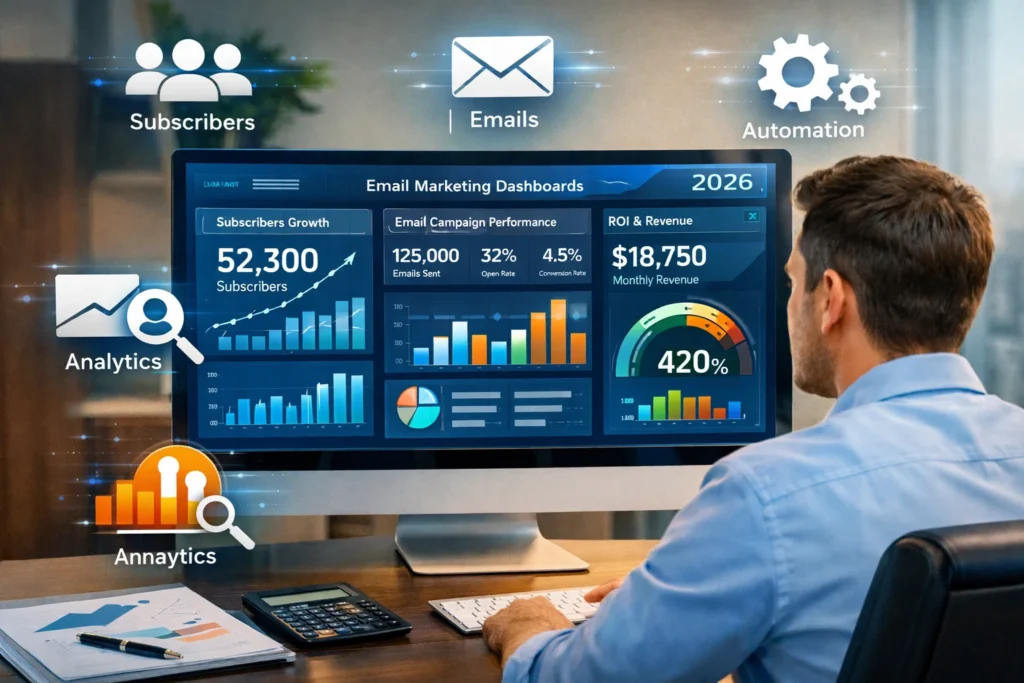
Email Marketing Software Pricing 2026 can be confusing at first glance. Many platforms advertise plans starting at just $10–$15 per month, making them seem perfect. But once you factor in automation, design, subscriber growth, and the time required to run campaigns, your actual costs can quickly add up. This guide is for small business owners, freelancers, and agencies who want to understand the true cost of email marketing in 2026, uncover hidden fees, and calculate ROI effectively.
This guide is for you. if:
- If you are a small business owner trying to create a budget for your campaigns.
- If you are a freelancer trying to decide between running campaigns yourself and hiring someone else to do it for you.
This guide will help you understand:
- What email marketing will cost you in 2026
- How freelancers and agency owners should approach email marketing
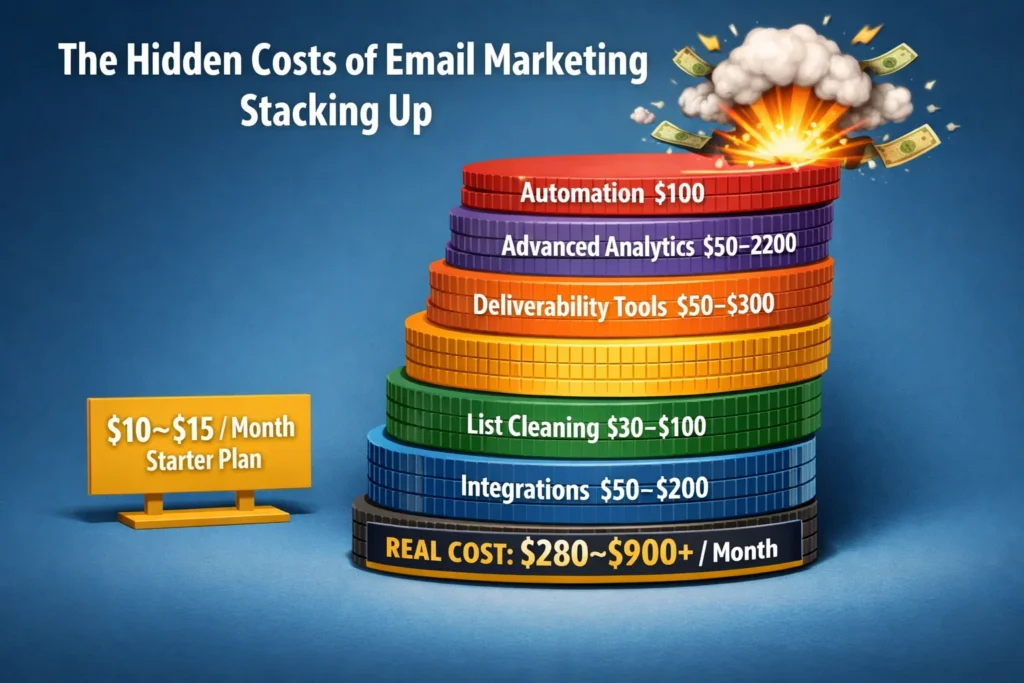
- Hidden costs of email marketing that can add 20 to 50 percent to your budget
- How can you calculate your ROI?
- How can chose the right email marketing plan for your business?
Email Marketing Software Pricing & How It Actually Works
Most email marketing plans offer three types of payment plans. Below is a brief overview that will help you decide which payment plan is right for you.
The Two Pricing Models

Pay for Subscribers
In Email Marketing Software Pricing 2026, one common plan is paying for subscribers. This straightforward model charges you based on the number of email subscribers you have, regardless of whether you send them emails or not.
- Your costs will rise as your subscriber list grows.
- The payment structure is predictable and easy to understand.
- It is ideal if you are focused on building and expanding your email list.
Pay for Emails Sent
Another pricing model in Email Marketing Software Pricing 2026 is paying for emails sent. You are charged only for the number of emails you send, making it perfect if you send occasional campaigns. Costs increase only when your email volume grows.
Why Starter Prices Can Be Misleading
Starter prices often seem low, but Email Marketing Software Pricing 2026 can quickly add up.
- A small subscriber list today may grow tomorrow, increasing your costs.
- Exceeding your send limit can lead to higher charges than expected—for example, a $50 plan could jump to $150.
- Hidden costs like premium templates, analytics, and automation tools can also increase your bill significantly.
Email Marketing Software Pricing Comparison Table
| Average Costs of Plans | Features that you might need | Typical Cost | Hidden Costs and Notes |
| Plan for beginners with a small subscriber list. | You will need a basic email builder, simple automation, & reporting features | It can cost $0 to $50/month | You should avoid paid templates & list cleaning; DIY campaigns work fine at this stage |
| If you own a Growing Business | You will need Automation for leads & abandoned carts, CRM integration, and advanced analytics features | It can cost $50 to $300/month. And $200 to $500/month, if you hire freelance support | Hidden costs expand your budget by 20 to 30%. Adding CRM integration can save your time & boost ROI |
| If you are an Agency owner | You will need Advanced automation & personalization, multi-user access, deep reporting, deliverability tools & complex integrations | $200 to $800/month (platform fee) $1,000–$10,000+ (agency) | Hidden costs include list cleaning, compliance tools, and advanced analytics. Only scale if your campaigns generate significant revenue |
| Subscriber-based pricing plan | Charges grow with your subscriber list | Charges vary by list size | It’s ideal if you are building a growing subscriber base; The payment structure is predictable & easy to understand |
| Email Send-Based Pricing | You pay for the number of emails you send | Charges vary based on the volume of emails you send | It is good for occasional emails; the cost grows with email frequency |
| Hidden Features / Extras | Advanced features like Predictive sending, conditional & dynamic logic, A/B testing, analytics, deliverability, and integrations | $20 to $300+/month | Can increase total costs by 20 to 50%; prioritize what you actually need |
| List Growth / Maintenance charges | List cleaning, verification | $0.003 to $0.01/contact | 10,000-contact list cleaning can cost $30 to $100 each time; It prevents paying for inactive subscribers |
Hidden Costs Most Businesses Should Be Aware of
You will find that most of the features that can optimize your workflow are actually hidden behind paywalls.
Automation and Advanced Features
- Predictive sending: sends emails based on the time your subscribers check their email inbox, and can cost $100 per month
- Conditional logic, whichtakes different actions based on the subscriber’s activity.
- Dynamic Logic: It tailors emails based on your subscribers’ gender or preferences.
- A/B testing tools that let you experiment with different subject lines and email content can cost $20 to $50 monthly.
- Advanced analytics and reporting tools, which let you know which of the emails is making sales and how much each email is earning, can cost you $50 to $200+ per month.
- Deliverability tools, like DKIM, SPF, DMARC setup, and spam testing, which help your emails land in the inbox instead of spam, can cost you $50 to $300 monthly.
Contact List Growth Costs
Growing your subscriber list works both ways; on one hand, it increases your revenue, and on the other hand, it increases your expenses.
- List cleaning can cost you $0.003 to $0.01 per email address. For example, if you clean a 10,000-contact list. It will cost you $30 to $100 each time.
Add-Ons and Integration Fees
You will reaize that that you need other tools to run email marketing campaigns.
- Integrations like CRM, e-commerce, and analytics usually require paid plans.
- The average cost of integration is between $50 and $200 per month. If you go for complex integrations, it can cost you one time setup fee of $500 to $2,000.
- You might need other tools, like design software, that can cost you $10 to $50/month
An Easy Guide to Choosing an Email Marketing Plan
For Beginners and Small Lists
If you are just starting, you will need a basic email builder, simple automation, and reporting.
Charges: You might be charged $0 to $50 per month
Avoid:
- Paid templates
- List cleaning services
At this point, it makes sense if you just run email campaigns yourself; there’s no need to invest in high-tier plans.
For Growing Businesses
If your business is expanding, you will need more advanced features such as
- Automation that nurtures leads and sends a reminder about abandoned carts.
- CRM integration
- Advanced analytics
Charges:
- You might be charged $50 to $300 per month, depending on the platform you use.
- If you hire freelance support, you might have to pay additional charges of $200 to $500 per month.
Investing in a CRM integration is worth it because it will sync everything automatically. It can save you tons of time. Other hidden costs like advanced automation, premium support & design help can increase your budget by 20–30%.
For High-Volume Senders and Agencies
If you have leveled up to an agency, then email has become one of your primary revenue generators.
You will need:
- Advanced automation and personalization
- Multi-user access
- Deep reporting
- Deliverability tools
- Complex integrations
Charges:
- If you subscribe to an advanced platform, you might have to pay $200 to $800 per month
- If you work with an agency, it can cost you $1,000 to $10,000+
Only do this if:
- Your Email campaigns are bringing in significant revenue
- You don’t have an email campaign expert in your agency
- You need someone to strategize, execute, & report professionally
If you are sending high-volumes of emails, you will also have to budget for:
- List cleaning and verification
- Compliance tools
- Advanced analytics
- Overage fees
Even small inefficiencies can cost you a lot. Integration and automation will keep costs under control.
Tips to Reduce Your Email Marketing Software Costs
- Choose the right pricing model for your business. If you have a large subscriber list chose a send-based plan. If your subscriber list is small, a subscriber-based plan will suit you better. Choosing the wrong pricing model will cost you extra money.
- Remove inactive subscribers from your list. Most platforms will charge you based on your subscriber list. There is no sense in paying for inactive subscribers.
- Only buy features you actually need. Start with a basic plan and add paid features as needed.
- Watchout for overage; track your sending and subscriber limit. If you go over the limit, you will be charged more.
- Avoid ordering custom design work. its better to stick with one or two high-converting email templates.
FAQ:
1. Why do email marketing plans appear to be inexpensive yet end up being more costly?
The starting costs are low, but the additional costs of automation, advanced templates, analytics, list cleaning, integrations, and overages can increase your expenses by 20-50%. As your list of subscribers increases, your expenses will increase as well.
2. What are the typical pricing structures for email marketing software?
There are two typical pricing structures for email marketing software:
Subscribers: You pay for the number of subscribers, regardless of the number of emails you send. Great for building your list gradually.
Email sends: You only pay for the number of emails you send. Ideal if you don’t send many emails.
3. What are the typical hidden features that increase costs?
Features such as predictive sending, conditional or dynamic logic, advanced A/B testing, in-depth analytics, deliverability features (DKIM, SPF, and DMARC), and CRM or ecommerce platform integrations can cost anywhere from $20 to $300+ per month.
4. How much does list growth or maintenance cost?
The cost of cleaning or checking an email list is around $0.003 to $0.01 per contact. This means that a list of 10,000 contacts will cost $30 to $100 each time you clean the list. The cost of list growth also translates to higher costs for subscriptions or sending emails.
5. How can freelancers or small businesses manage email marketing costs effectively?
Begin with a basic plan that has only the necessary features.
Avoid using paid templates and advanced features until you need them.
Unsubscribe inactive contacts to reduce subscription costs.
Monitor your sending and subscriber limits to prevent additional fees.
6. What should growing businesses consider when choosing a plan?
Growing businesses require more automation, CRM integration, and analysis capabilities. The monthly costs will range from $50 to $300, with the option to hire a freelancer for an additional $200 to $500. Spending money on CRM and automation tools can save time and increase ROI.
Final Thoughts:
Email marketing isn’t just about knowing plan prices. It’s about understanding overall costs such as the cost of automation, analytics, and list growth. If you are a beginner, it’s completely fine to start with basic tools. But as your business grows You will have to invest in automation & CRM tools. If you are an agency owner, you will need to invest in an advanced email marketing tool.
Remember to pay only for features that you use. Clean your subscriber list frequently & vet the price plans before selecting one. If you do it right, email marketing can generate serious revenue for your business.